Table of content

This military time converter lets you change regular time into military time and convert military time back to standard format with ease. Enter any hour to get a fast result for schedules, work shifts, travel plans, digital clocks, and everyday time conversion.
Using the military time converter is quick and straightforward. You can switch from standard time to military time or convert military time back to regular time in just a few steps.
Enter the time you want to convert.
Type your time in either standard format, such as 2:30 PM, or military format, such as 1430.
Choose the conversion direction.
Select whether you want to convert to military time or convert military time to regular time.
Click the convert button.
The tool will process your input instantly and display the matching time format.
Check the result.
You will see the converted time clearly, so you can use it for schedules, forms, travel plans, work shifts, or daily time tracking.
Repeat for another value if needed.
You can enter a new time anytime to make another conversion without doing the calculation manually.
This tool is useful when you need a fast answer and want to avoid mistakes with AM, PM, noon, midnight, or 24-hour clock formatting.
This military time converter covers the most common time format changes people need in daily use. Whether you want to convert a regular clock time into military format or turn a 24-hour value back into standard time, the tool gives you a quick result without extra steps.
It can convert:
Standard time to military time
Change times like 7:00 AM or 4:45 PM into military format such as 0700 or 1645.
Military time to regular time
Turn values like 1300 or 2130 into standard time with AM or PM.
12-hour time to 24-hour time
Convert everyday clock format into a 24-hour format used in schedules, systems, and official records.
24-hour time to 12-hour time
Change 24-hour clock entries into a more familiar format for easier reading.
AM and PM time formats
Convert morning and afternoon times clearly, including noon and midnight.
Common army and military clock values
Check familiar conversions like 0900, 1200, 1800, and 2300 in seconds.
You can use it for work shifts, travel plans, digital devices, appointment times, timetables, and any situation where a clear time format matters.
When you use a military time converter, the result shows the same point in the day in a different time format. The hour does not change in real life, only the way it is written changes. This makes it easier to read schedules, records, digital displays, and time-based entries without mixing up AM and PM.
Here is what your result tells you:
If the output is in military time, it shows the hour in a 24-hour format without AM or PM.
For example, 1:00 PM becomes 1300.
If the output is in regular time, it changes a 24-hour value into a standard 12-hour clock format.
For example, 1830 becomes 6:30 PM.
Morning times usually stay closer to the original hour, while afternoon and evening times shift into the 13:00 to 23:59 range in military format.
Special cases matter too.
0000 means 12:00 AM and 1200 means 12:00 PM.
A few quick examples make it even clearer:
9:00 AM = 0900
2:15 PM = 1415
2100 = 9:00 PM
0730 = 7:30 AM
This result can be used right away for work shifts, travel plans, medical forms, appointment times, school schedules, and any situation where a clear time format matters.
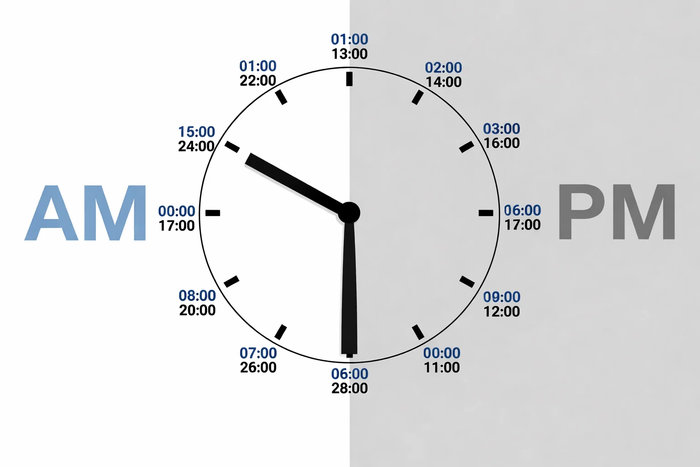
Converting standard time to military time becomes much easier once you know how the 24-hour format works. Military time does not use AM or PM, so each hour of the day appears only once. Morning hours stay close to regular time, while afternoon and evening hours shift into a higher number range.
For AM times, the hour usually stays the same. The main difference is that single-digit hours need a leading zero in military format.
Examples:
1:00 AM = 0100
6:30 AM = 0630
9:15 AM = 0915
11:45 AM = 1145
This is one of the easiest parts of the conversion. If the time is in the morning, you usually keep the hour and minutes as they are, then add a zero in front when the hour has only one digit.
For PM times after 12:00 PM, add 12 to the hour and keep the minutes the same. This changes the time into military format without using PM.
Examples:
1:00 PM = 1300
2:30 PM = 1430
5:45 PM = 1745
8:20 PM = 2020
11:10 PM = 2310
This is the part that people use most often when converting regular time into military time. Once you know that 3:00 PM becomes 1500 and 7:00 PM becomes 1900, the pattern is easy to follow.
Noon and midnight are the two values that cause the most mistakes, so they are worth remembering on their own.
12:00 AM = 0000
12:00 PM = 1200
Midnight starts the new day, so it becomes 0000. Noon stays 1200 and does not change further.
A simple way to remember the full rule is this: morning times keep their hour, afternoon and evening times add 12, midnight becomes 0000, and noon stays 1200.
A quick military time chart makes common conversions easier to read at a glance. Instead of calculating each hour manually, you can match regular time with its 24-hour format in seconds. This is especially useful for schedules, shift planning, travel details, digital clocks, and everyday time checks.
Here are some of the most common military time conversions:
| Standard Time | 24-Hour Format |
|---|---|
| 12:00 AM | 0000 |
| 1:00 AM | 0100 |
| 2:00 AM | 0200 |
| 3:00 AM | 0300 |
| 4:00 AM | 0400 |
| 5:00 AM | 0500 |
| 6:00 AM | 0600 |
| 7:00 AM | 0700 |
| 8:00 AM | 0800 |
| 9:00 AM | 0900 |
| 10:00 AM | 1000 |
| 11:00 AM | 1100 |
| 12:00 PM | 1200 |
| 1:00 PM | 1300 |
| 2:00 PM | 1400 |
| 3:00 PM | 1500 |
| 4:00 PM | 1600 |
| 5:00 PM | 1700 |
| 6:00 PM | 1800 |
| 7:00 PM | 1900 |
| 8:00 PM | 2000 |
| 9:00 PM | 2100 |
| 10:00 PM | 2200 |
| 11:00 PM | 2300 |
This table covers the full day from midnight to late evening, so it is useful when you want a fast lookup without converting each hour yourself. The most important values to remember are often 0000 for midnight, 1200 for noon, and any hour from 1300 onward for afternoon and evening times.
The basic military time formula is simple once you separate morning hours from afternoon and evening hours. For AM times, the hour usually stays the same, and single-digit hours take a leading zero. For example, 7:00 AM = 0700 and 9:25 AM = 0925.
For PM times after 12:00 PM, use this rule: Military hour = standard hour + 12. So 1:00 PM = 1300, 4:30 PM = 1630, and 8:45 PM = 2045.
To convert in the other direction, use this formula for military times from 1300 to 2359: Standard hour = military hour − 12. For example, 1500 = 3:00 PM and 2130 = 9:30 PM.
Two special values are worth remembering on their own: 12:00 AM = 0000 and 12:00 PM = 1200. Once you know these patterns, military time becomes much easier to read and convert quickly.
Military time appears in many situations where clarity matters and AM/PM confusion is not acceptable. You’ll often see it used in systems, schedules, and environments that require precise timing.
Common places you’ll see military time:
2100 = 9:00 PM1735 = 5:35 PM departure2300–0700 shows an overnight shift clearly00:15 = 12:15 AM event logIn these cases, using a military time converter makes it easy to switch between standard time and the 24-hour format, especially when reading schedules or entering data.
Watch this quick example of how military time is used in real work environments:
Encyclopaedia Britannica – 24-hour clock | Definition, History, Uses, & Facts
https://www.britannica.com/topic/24-hour-clock
National Institute of Standards and Technology (2024) – Times of Day FAQs
https://www.nist.gov/pml/time-and-frequency-division/times-day-faqs
Department of the Navy (2015) – SECNAV M-5216.5 Correspondence Manual
https://www.marines.mil/portals/1/publications/secnav%20m%205216.5.pdf
Naval Service Training Command (2024) – NJROTC Cadet Reference Manual, Fourth Edition
https://www.netc.navy.mil/Portals/46/NSTC/NJROTC/docs/Manuals/2024%20CRM%204th%20Edition%20%280509-LP-002-6029%29%2018%20APR%202024.pdf
In most cases, yes. Both use a 24-hour format instead of repeating a 12-hour cycle. The main difference is that military time is often written without a colon, such as 1730, while a standard 24-hour clock may appear as 17:30.
0000 means 12:00 AM, which is midnight. It marks the start of a new day in military time.
1200 means 12:00 PM, which is noon. This is one of the most important values to remember because it is often confused with midnight
Military time avoids confusion by using one full 24-hour cycle. This makes schedules, records, and official communication more precise, especially in fields where timing must be clear.
A converter gives you a fast result and reduces mistakes, especially with tricky values like 12:00 AM, 12:00 PM, 0000, and 1200. It is also useful when you need to check many time values quickly.
Military-time-converter.com was built to make 12-hour and 24-hour time conversion simple, fast, and stress-free for anyone who needs clear and accurate time formatting. Whether you're studying military time, working with schedules, traveling, or using international time systems, this tool helps you convert with confidence in just seconds.
Behind this tool is the Military-time-converter.com team, a group of contributors who focus on creating practical digital tools that turn everyday calculations and conversions into smooth, user-friendly experiences.
We believe simple tools should come with clear expectations—no confusion, no hidden details.
Military-time-converter.com runs entirely in your browser. It does not require sign-ups, and it does not store, track, or share any of the time values you enter.
This tool is designed to provide quick and reliable conversions between 12-hour and 24-hour (military) time formats. While highly accurate for standard use, it should not replace official timekeeping systems in critical environments.
The converter is built for everyday use—learning, scheduling, travel, and general reference. By using it, you agree that results are provided for convenience and should be verified if used in professional or time-sensitive situations.
We may improve or refine this tool over time. Any updates to this Policy will appear here, keeping everything open and transparent.